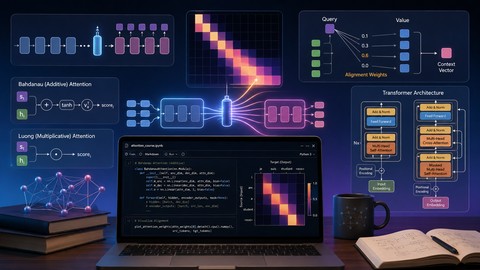
Course Overview
This course covers the development of attention mechanisms and Transformer models from the ground up using PyTorch. It begins with the limitations of RNN Seq2Seq models and progresses through the derivation and implementation of Bahdanau and Luong attention mechanisms. The course then explores the Transformer architecture in detail, including positional encoding, multi-head attention, and feed-forward blocks, culminating in assembling and training a complete Transformer for translation tasks.
Key Takeaways
- Understand and measure the fixed-context-vector problem in RNN Seq2Seq models.
- Derive and implement additive (Bahdanau) and multiplicative (Luong) attention mechanisms in PyTorch.
- Read and map the “Attention Is All You Need” paper components to code.
- Implement positional encoding, masking, multi-head attention, Add & Norm, and feed-forward blocks.
- Assemble, train, and use a complete Transformer model for translation and analyze its cross-attention.
Prerequisites
- Python 3.10+ installed or access to Google Colab.
- Comfortable reading Python code; expert level not required.
- Basic knowledge of PyTorch and understanding of RNNs.
Target Learners
- Developers using Transformers who want a deeper understanding of the mechanism.
- Students beginning NLP or preparing for deep learning interviews.
- Engineers interested in building Transformers from components rather than using pre-built models.
- 1 What AI can do with language 3:56
- 2 Why attention? 4:07
- 3 The NLP engineer roadmap 5:24
- 1 Opening questions and the Seq2Seq idea 5:56
- 2 How a Seq2Seq model is implemented 8:29
- 3 The problem with a fixed context vector 7:28
- 4 The arrival of attention 7:50
- 1 Data, encoder and decoder in PyTorch 9:19
- 2 Training setup and the first run 7:09
- 3 Does a wider hidden state help? Sweeps 5:20
- 1 The core idea of attention 6:09
- 2 Bahdanau attention in detail 9:19
- 3 Implementing Bahdanau attention 5:45
- 1 Bahdanau attention: additive scoring, training and alignment 12:55
- 2 Luong attention: multiplicative scoring 9:23
- 1 Self-attention 8:21
- 2 Multi-head attention and positional encoding 9:54
- 3 Reading Attention Is All You Need 9:48
- 4 Feed-forward, encoder, decoder and assembly 5:54
- 1 Positional encoding 8:28
- 2 Masking 5:09
- 3 From one head to many 5:09
- 4 Multi-head attention and what the loop costs 6:27
- 5 Add and Norm, feed-forward, encoder and decoder layers 8:31
- 6 Final assembly and training 7:24
- 7 Translating, cross-attention and what we built 8:00
- 1 What we learned 6:04
- 2 Where to go next 5:40
Access Files No pi required.
Free Course files 1 file package
- Udemy - Attention and Transformers from Scratch
Discussions are closed
Comments are currently disabled for this course.